If you've reached the point where your sim rig is doing the job, but no longer feels quite as in tune as you want it, your steering wheel is often one of the first places you notice it.
Once you move beyond entry-level gear, the question of "which wheel actually suits the way I drive," becomes more prominent. The right shape, layout and ecosystem can make your inputs feel cleaner and sharper.
That is exactly where the Zeus range stands out. Rather than treating the wheel as a single isolated purchase, the Zeus collection is built around a more connected, modular approach. For sim racers looking to refine their setup, that makes a real difference.
What makes the Zeus range different?
The Zeus range is designed for sim racers who want more than just a visual upgrade. It is built around the idea of creating a setup that feels more deliberate, more cohesive and better matched to the cars you actually drive.
Instead of forcing you into a one-size-fits-all option, the range gives you distinct wheel styles for different driving preferences, alongside accessories and display options that help tie the whole cockpit together.
For drivers who are serious about improving the feel and usability, that matters. A well-chosen wheel does more than change the look of your rig. It affects how naturally your hands sit, how confidently you make corrections, how comfortable longer sessions feel and how connected you are to the car over a race distance.
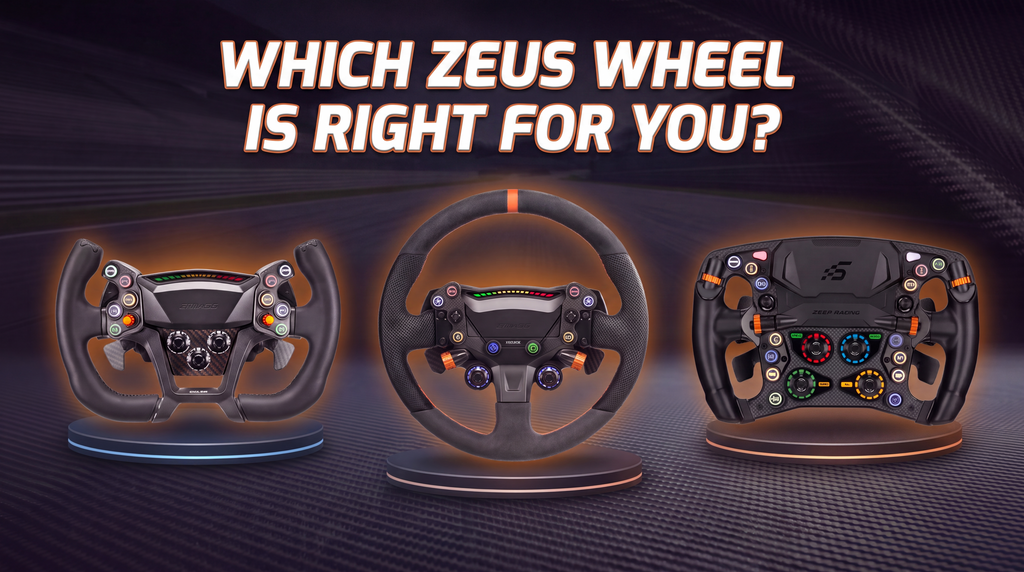
Formula, GT or Sport: where should you start?
For many sim racers, the best way to choose a wheel is by thinking about the type of driving you spend most of your time doing.
Zeus Formula: for precision and fast inputs.
If your sim time is built around high-downforce cars, single-seaters or anything that rewards quick, precise steering inputs, a formula-style wheel makes immediate sense.
The more compact, focused layout helps keep your hand position consistent and your movements efficient. That can make the car feel sharper through direction changes and give your cockpit a more purpose-built feel for open-wheel and modern prototype driving.
For experienced drivers, that sense of precision is often what makes the upgrade worthwhile. Everything feels more intentional, from how you place the car to how you manage those smaller mid-corner corrections.
Zeus GT: for versatility and long-session confidence.
For sim racers who spend more time in GT cars, endurance racing or a wider mix of disciplines, a GT-style wheel is often the most natural fit.
This style tends to strike a strong balance between control, comfort and versatility. It feels at home in longer sessions, gives you a confident grip in heavier cars and works well if your driving rotates between the different series rather than staying locked to one format.
If you want one wheel that feels composed and easy to live with across a broad range of racing, GT is usually the safest place to start.
Zeus Sport: for a more open, adaptable feel.
The Sport option sits in a useful middle ground for sim racers who want something performance-led but a little less specialised in feel.
For some drivers, that makes it an appealing choice when building a setup that needs to stay flexible. If your rig is used for a mix of cars, driving styles or shared sessions, a wheel that feels adaptable can be just as valuable as one that is highly specific.
The real advantage here is freedom. Rather than locking your setup into one narrow use case, you get a wheel that can support an evolving sim racing habit as your preferences change.
Why wheel choice matters more once you upgrade your rig
When you are first getting into sim racing, almost any wheel can feel like a big step forward. But once your setup becomes more serious, the smaller details start to matter more.
That is when wheel choice begins to affect the overall experience in a much bigger way.
A wheel that suits your driving style can help with:
- more natural hand placement during longer sessions
- better confidence when making fast corrections
- a stronger sense of connection through corners and transitions
- a cockpit that feels more coherent and purpose-built
- a setup that is easier to grow over time
This is why experienced sim racers rarely think about the wheel as a cosmetic extra. It becomes part of how the whole rig works and how enjoyable it feels to use week after week.
The value of a modular ecosystem
If you are deciding where to start, keep it simple.
Ask yourself:
- What do I drive most often?
If the answer is formula or prototype machinery, start by looking at a Formula-style option. If it is GT, endurance or mixed-category racing, GT or Sport may make more sense. - Do I want a specialised wheel or an all-rounder?
Some sim racers want a setup that feels tightly focused on one type of driving. Others want something that can cover a broader range without feeling too compromised. - Am I only changing the wheel, or improving the whole cockpit experience?
If you are already thinking about displays, accessories and how everything works together, the Zeus ecosystem becomes even more appealing. - What do I want to feel more on track?
Faster hand movement, better comfort, more confidence over longer stints, clearer information in front of you or simply a more complete feeling cockpit can all point you towards a different choice.
Final thoughts
A good upgrade should do more than give your rig a new look. It should make the whole driving experience feel sharper, more comfortable and more aligned with the way you actually race.
That is what makes the Zeus range so interesting. Whether you are drawn to the focused feel of Formula, the all-round capability of GT or the flexibility of Sport, the collection gives you room to build a setup around your driving rather than forcing your driving to adapt to the hardware.